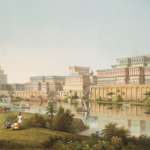
An ancient archaeological city, built in the nineteenth century BC. It is considered one of the oldest and greatest cities in the ancient era. It is located in Mesopotamia in northern Iraq on the right bank of the Tigris River and was the capital of the Assyrian Empire. Nineveh was the largest city in the world during the period of the Neo-Assyrian Empire, and its remains are spread on the left side of the city of Mosul in the Nineveh Governorate in northern Iraq on the eastern bank of the Tigris River.
Nineveh was destroyed after the Battle of Nineveh in 612 BC after it was invaded by Nabopolassar, King of Babylon, in alliance with the Medes, Chaldeans, Armenians, and Cimmerians, which led to the destruction and plunder of the city and the fall of the Neo-Assyrian Empire.
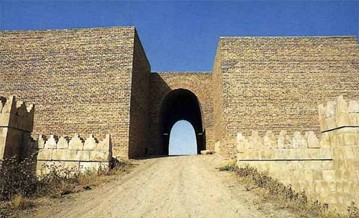

The ancient history of the city of Nineveh states that it was surrounded by a rock wall, about seven meters high, interspersed with 18 gates, the most prominent of which is this Al-Masqa gate, which overlooked the Tigris River.

Some of the inscriptions found on the walls of palaces and walls


Mosul Castle
Bashtabiya Castle or Mosul Castle is an ancient castle located on the right side of the ancient city of Mosul in Nineveh Governorate in northern Iraq on the left bank of the Tigris River. Its founding dates back to the second century AH.
The ruins of Bashtabiya Castle are considered one of the archaeological sites in Mosul, as they are considered the remaining part of the Mosul Wall. The castle consists of a high tower, rooms, a fort, a grate, underground tunnels linking the castle with the old city, other secret tunnels outside the city, and

Shrine of Prophet Yunus
The Shrine of Prophet Yunus is located in the city of Mosul in Iraq, on the west bank of the Tigris River. It is believed that the Prophet Yunus, peace be upon him, was buried in this place after God saved him from the belly of the whale. It is one of the historical and archaeological mosques of Iraq. It is located on the western slope of the Hill of Repentance, or the Hill of the Prophet Yunus in Mosul. It was mentioned by some

Historians say that the Prophet Yunus is buried near the mosque. The shrine is distinguished by its location on a high hill, overlooking the entire city. It consists of a golden-domed building, surrounded by a large square.
Iraqi archaeologists expect that tunnels located under a shrine destroyed by ISIS militants go back to the palace of the Assyrian King Esarhaddon, where ancient manuscripts and inscriptions depicting winged bulls and lions were found on the walls of the tunnels at a great depth. These walls are expected to be part of the palace of a king who ruled the New Ashouri Empire 2,700 years ago. Esarhaddon ruled the New Assyria Empire in the 7th century BC.


Mar Georges Monastery
The oldest monastery in Nineveh Governorate. It is located 9 km north of Mosul city center, and 800 meters to the right of the road leading from Mosul to Dohuk. In 1681, the monastery was restored and rebuilt in 1906. This monastery is named after the patron saint of the monastery, the martyr Mar Georges, or George.

Saint Matthew Monastery
It is an ancient monastery located on Mount Alfaf, north of the city of Mosul, and is considered one of the well-known tourist attractions in Iraq. It was founded by Saint Matthew in the late fourth century AD. It included a church, cisterns, and cells for the monks to live in, and was surrounded by a large wall.
Then there is a place which is known as “Al-Tabki,” which is a Syriac word meaning “uplifting.” The church and monastery are considered one of the most important and beautiful archaeological and tourist sites in the northern Mosul area.

Rabban Hormuz Monastery
An ancient monastery located near the town of Alqosh in northern Iraq, about 3 kilometers northeast of the town above Mount Alqosh. Its construction dates back to the year 640. Upon his death, two Assyrian princes decided to build a monastery to commemorate his memory. This was completed in the year 640, and a large number of people joined it. From the monks until it became an important cultural and religious center in the region, especially in the tenth century.
The monastery is considered one of the most famous monasteries in Iraq and the Middle East, as it occupied a prominent position in the Church of the East, especially in the tenth and eleventh centuries, when it became the center of the church that expanded eastward to include millions in Persia, Central Asia, and China.

Tomb of the Prophet Nahum
He is considered one of the minor prophets whose prophecy was written in the Old Testament. His book was arranged chronologically between the Book of Micah and the Book of Habakkuk.
He wrote about the end of the Assyrian Empire and its capital, Nineveh, in a lively poetic style. He lived in the seventh century BC and his shrine is located in Iraq, the city of Alqosh.